

The Best Grain Mills For The Home Baker
This post may contain affiliate links. Read disclosure policy.
If you’re a home baker looking to make your whole wheat bread, pastries, and other baked goods with freshly milled flour, check out my guide on the best grain mills. Investing in a high-quality grain mill is a must if you are wanting to make fresh milled flour.
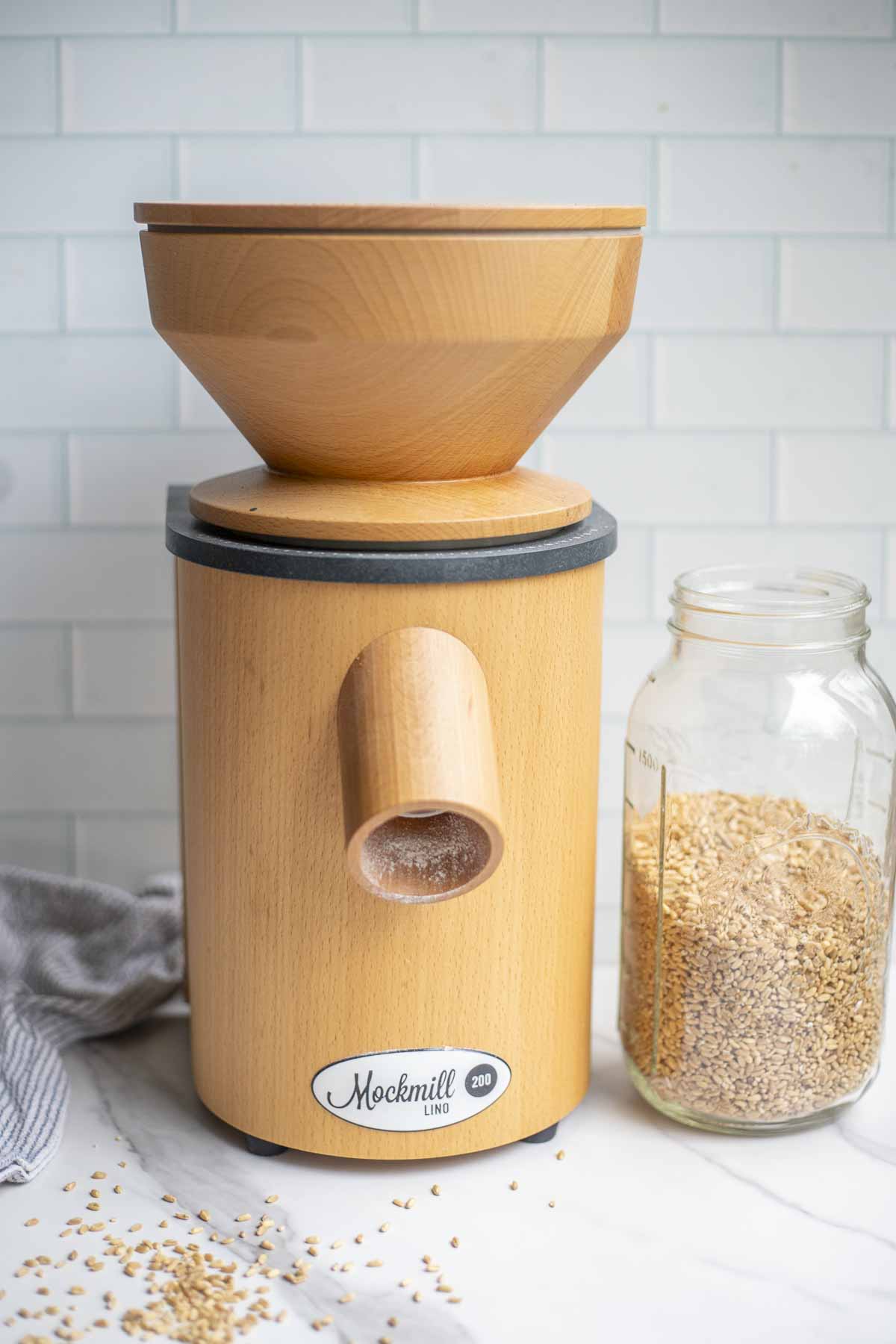
Making your own flour at home is becoming much more popular lately, and for good reason. Freshly milled flour retains more nutrients and flavor compared to flour purchased at the grocery store, making it a healthier and more flavorful choice for your baking projects like whole wheat sourdough pizza dough or these yummy fresh milled sourdough blueberry muffins.
There are several grain mills available on the market today, each with its own set of features, advantages, and drawbacks.
Honestly, so many options can be overwhelming when you decide you want to start milling your own grain (learn how to mill your own flour here). Personally, I tend to get stuck when there are so many different options, and I’m likely to give up altogether.
In this post, I’ll try to provide you with helpful information to find which is the right grain mill for you.
We’ll take a look at some of the most popular home grain mills, like Mockmill, Nutrimill Original, Nutrimill Harvest, KitchenAid Grain Mill Attachment, Komo, and WonderMill, and then compare their performance, pros, and cons.
Grain Mill Basics: Stone Mills vs. Compact Grinders
Before we jump in, let’s cover the different mills that are available.
Stone Mills
Stone mills use two, large, flat stones to grind grains. The top stone rotates against a stationary bottom stone, and the grain is crushed between the two.
This process tends to produce finer, more uniform flour and is often preferred by those looking for traditional, slower milling methods. Stone mills are usually better at processing whole grain flours, as they retain the bran and germ.
Compact Grinders
These mills use stainless steel or ceramic burrs to grind grains. Compact grinders generally work faster than stone mills and tend to be smaller and more affordable.
They are versatile and can grind a wider variety of grains, but they may generate more heat, which can slightly reduce the nutritional value of the flour.
Manual Grain Mills
Manual mills are operated by hand and require physical effort to grind grains. Typically built with durable materials like cast iron or steel, they can be adjusted for different coarseness levels.
A hand crank mill is ideal for those who prefer a more traditional, off-grid option or for small batches of flour. They are portable, require no electricity, and offer a quiet, hands-on milling experience.
Electric Grain Mills
Powered by electricity, electric models can quickly grind larger quantities of grain with minimal effort. They are ideal for users who need convenience and speed, as they can produce fine flour in seconds.
Electric mills are available in various models, ranging from stand mixer attachments to countertop mills. While they require a power source, they offer efficiency and consistency, making them suitable for regular use in homes or small businesses.
Best Home Grain Mills
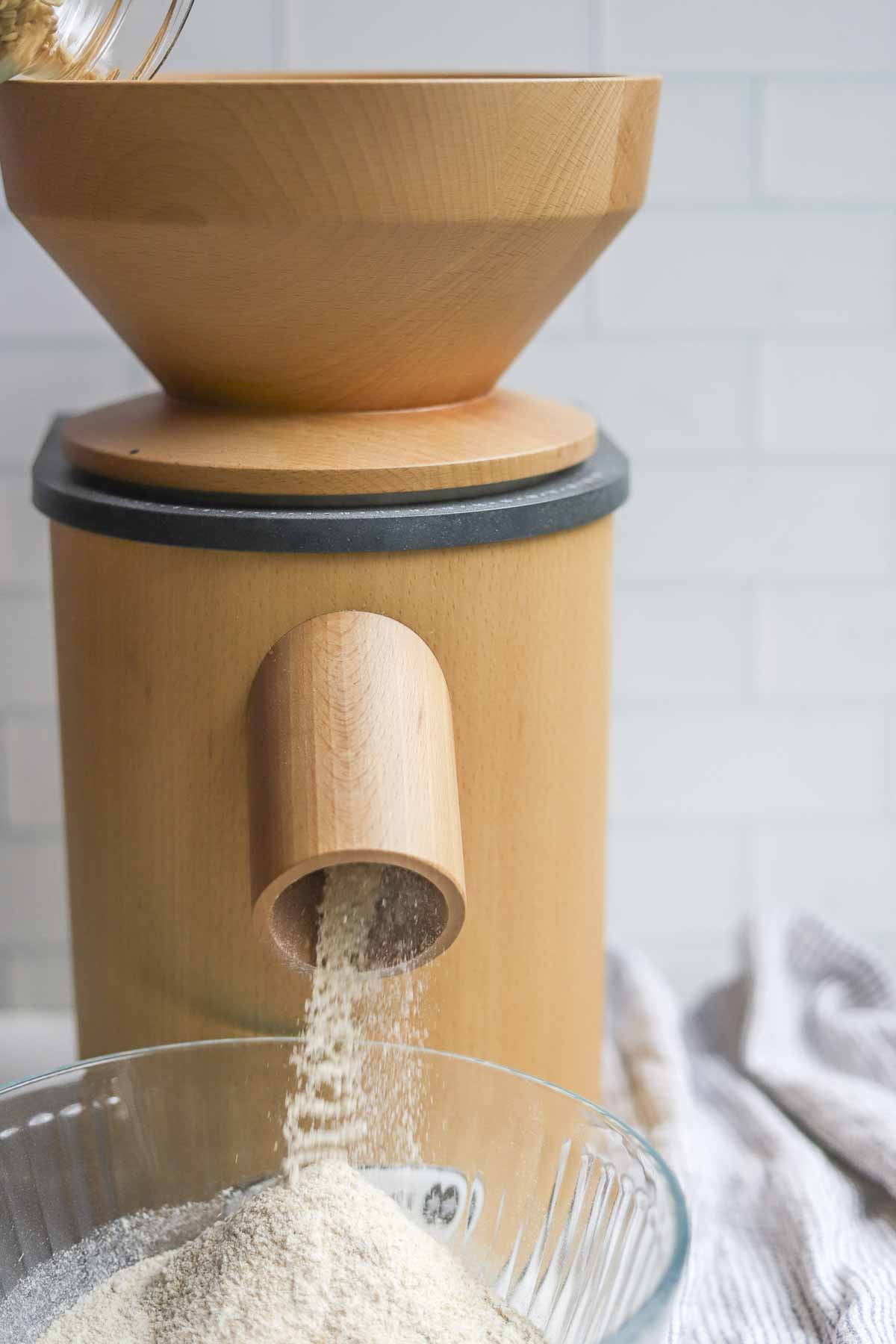
Mockmill 100 and 200 Grain Mill
I’ve had the Mockmill Lino 200 for a number of years and love it. It is super high quality, heavy-duty, and mills the grain pretty quickly with very consistent results. Plus, it is beautiful and lives on my kitchen counter all the time.
Pros:
- High-quality milling: The Mockmill is a stone mill that consistently delivers finely ground flour thanks to its high-performance corundum ceramic grinding stones.
- Affordable: Mockmill offers a great balance between price and quality. They offer two options for their home mills: a more affordable option and a more expensive version in a wood housing. The main difference is wood housing versus a plastic housing made from renewable resources. They run $342-$700 depending on the model. They also offer a more affordable stand mixer attachment for $228.
- Quiet operation: The Mockmill operates relatively quietly, making it more pleasant to use in a home kitchen.
- Compact design: The Mockmill has a small footprint, so it’s easy to store in most kitchens.
Cons:
- Manual setup: When it first arrives, you do need to put it together and clean the grinders, but otherwise it is pretty hands-off.
- Lower capacity: The Mockmill isn’t as fast as some larger mills, and its smaller hopper means it requires frequent refilling when grinding large batches compared to the Nutrimill Original.
Best for: Home bakers who want high-quality flour at an affordable price and have the patience for a slower grinding process.
Nutrimill Original
Pros:
- Powerful performance: The Nutrimill Original features a powerful motor and high-speed impact milling system, making it ideal for grinding large amounts of flour quickly.
- Large capacity: Its 20-cup flour container allows you to grind more grain at once, making it perfect for bulk bakers or those who mill flour in larger quantities.
- Adjustable texture: You can adjust the mill to produce a range of flour textures, from fine pastry flour to coarser bread flour.
- Quiet operation: Despite its power, the Nutrimill Original operates relatively quietly compared to some other impact mills.
- Price: It’s right in the middle in terms of price, which might not suit every budget. Definitely not the most expensive, but also not the cheapest at $299. Nutrimill also offers a new compact mill at a $199 price point.
Cons:
- Heat generation: The faster grinding speed of compact grinders can generate heat, which may slightly reduce the nutrient content of the flour.
- Bulkier design: It’s larger and more cumbersome than some other mills, so it takes up more counter space.
Best for: Home bakers who need a powerful mill for grinding larger quantities of flour quickly and are less concerned about heat generation.
Save This Recipe
Nutrimill Harvest Grain Mill
Pros:
- Stone milling: The Nutrimill Harvest is a stone mill, which is great for keeping the grain’s nutrients intact. It uses high-quality corundum stone burrs for fine and consistent flour.
- Compact and attractive: Its sleek, wooden design makes it a stylish addition to any kitchen, and it has a smaller footprint than the Nutrimill Original.
- Quiet and efficient: It operates quietly and efficiently, and the grind speed is slower than impact mills, which can help preserve nutrients.
- Adjustable grind settings: The Nutrimill Harvest has a wide range of grind settings, allowing you to adjust from fine flour to coarser grinds for cereals or cracked wheat.
Cons:
- Lower capacity: The hopper only holds about 1.5 pounds of grain, so it’s not as suited for bulk grinding as some other mills.
- Manual labor: Although it’s quieter than other mills, it’s still slower and requires more attention during the milling process.
- Price: While on the more expensive side for home mills, it’s still a pretty typical price for a stone ground mill at $449.
Best for: Home bakers who prioritize natural, stone-ground flour and need a compact, yet stylish mill for smaller batches.
KitchenAid Grain Mill Attachment
Pros:
- Convenient: This attachment works with your existing KitchenAid stand mixer, meaning you don’t need to buy a separate appliance. It’s a great option if you already own a KitchenAid mixer.
- Affordable: It’s one of the most affordable options for a grain mill, making it an excellent choice for those on a budget at $150.
- Compact: Since it attaches directly to your stand mixer, it doesn’t take up much extra space in your kitchen.
Cons:
- Small capacity: The hopper holds only about 1.5 cups of grain, so you’ll need to refill it frequently for larger batches.
- Less powerful: The KitchenAid attachment isn’t as powerful as standalone grain mills, so it might struggle with harder grains or larger quantities.
- Limited versatility: It doesn’t offer as many grinding options as other mills, and it’s less efficient for large-scale milling.
Best for: Those who already own a KitchenAid mixer and want a budget-friendly, compact grain mill for occasional use.
Komo Classic Grain Mill
Pros:
- Top-quality milling: The Komo mill uses high-quality ceramic and corundum stones, offering excellent milling performance with a consistent and fine texture.
- Durable: Known for its solid build quality, this mill is designed to last for years. It also has an amazing 12-year warranty.
- Quiet: It operates much more quietly than many other mills, which is a big plus for home bakers.
- Adjustable grind settings: You can easily adjust the mill to produce a variety of flour textures from very fine to coarse.
Cons:
- High price: The Komo Classic is one of the more expensive grain mills on the market starting at $449.
- Smaller capacity: The hopper holds almost 2 lbs of grain, which means you may need to refill it often if you’re grinding large quantities.
Best for: Home bakers who want a high-quality stone mill with a sleek design and are willing to invest in a long-lasting appliance.
WonderMill Grain Mill
Pros:
- Powerful performance: This mill uses an impact milling system, making it one of the fastest mills available. It can grind up to 100 pounds of flour per hour.
- Versatility: It can mill not only wheat, but also other grains, beans, and even spices.
- Quiet operation: Unlike other high-speed mills, the WonderMill is relatively quiet, which is a big plus for home bakers.
- Large capacity: The WonderMill features a large hopper and flour container, making it perfect for bulk milling.
- Price: It’s the middle ground compared to some other mills on the market. Priced right at $300.
Cons:
- Heat generation: Like other impact mills, the WonderMill can generate heat, which might slightly reduce the nutritional value of the flour.
- Bulkier design: The WonderMill is larger and heavier, so it may not be ideal for small kitchens.
Best for: Home bakers who need a high-capacity, fast, and versatile grain mill for large batches of flour.
Choosing the Best Grain Mill
When it comes to choosing the best grain mill for your home baking, it depends on your priorities.
Here’s a quick summary of the best options:
- Mockmill: Great for those who want a high-quality stone mill at an affordable price. $342-$700
- Nutrimill Original: Ideal for bakers who need fast, powerful milling for large batches. $299 or $199 for the compact
- Nutrimill Harvest: Best for those who want a stylish, compact stone mill for smaller batches. $449
- KitchenAid Grain Mill Attachment: Perfect for occasional milling and those with a KitchenAid stand mixer. $150
- Komo Classic: Ideal for those looking for a durable, quiet, high-quality stone mill. $449
- WonderMill: Best for high-volume bakers who need speed and versatility. $300
- High-powered blenders: Although not in the comparison, some high-powered blenders like the Vitamix claim they can mill wheat berries. My friend tried this and found it took forever and the results were inconsistent.
No matter which grain mill you choose, milling your own fresh flour will bring you a step closer to healthier, more flavorful baked goods.
And if you are just wondering, it is only recommended to mill dry grains like soft and hard wheat berries, white rice, oats, quinoa, and some can even do corn. It is not recommended to grind oily seeds, coffee beans, nuts for nut butters, or peanuts to make peanut butter.
This is such an amazing post